


TL;DR: Visceral belly fat isn’t just cosmetic, it’s metabolically active tissue that drives insulin resistance and disrupts sex hormones differently in men and women, lowering SHBG and raising free testosterone in women (linked to PCOS, acne and hair loss) while raising SHBG and estrogen conversion in men (linked to lower testosterone, gynecomastia and prostate issues). Hormone testing can identify these disturbances early, guiding a targeted integrative treatment plan.
IS OUR BELLY FAT CREATING TOO MUCH OF THE WRONG HORMONES?
As we head into summer, we become more aware of our looks, body imperfections, and particularly extra weight. Entire our focus in this period is on how as quickly as possible to get rid of excess weight by all means: frequent gym visits, jogging, dieting, starving, aesthetic procedures, etc. Nevertheless, often, this process is not fast and not as successful as we wanted to be.
Many wrong food choices that we made in the past affect our bodies in a much more harming way than what it seems at the time of consuming those foods. A plate of chips or an ice cream may seem “benign,” but numerous wrong food choices influence blood sugar control and can cause long term hormone disturbances.
Some extra weight around the middle is usually seen by many as an aesthetic imperfection, an annoying feature that stops them from having that gorgeous summer body. Unfortunately, this understanding cannot be farther from the truth.
WHAT IS OUR BELLY FAT “TRYING TO TELL US”?
In the belly area, there are two forms of fat: subcutaneous fat and visceral fat.
Subcutaneous fat that is positioned right underneath the skin often called “the spare tire” in male or “muffin top “in females is relatively innocent in creating underlying pathologies and hormonal problems. However, if present alongside visceral fat, it can become impossible to lose.
Visceral fat also called “central obesity” refers to the fat situated inside the abdomen, tightly packed between the internal organs (liver, intestines, stomach, kidneys, spleen, etc.). Visceral fat is metabolically active via inflammatory cytokines, and it is responsible for metabolic disturbance affecting the whole body. Women usually develop visceral fat, during perimenopause and menopause, and in a highly stressful situation, and men are somehow more prone to develop visceral fat at any age. Visceral fat is significantly associated with serious health risks such as type 2 diabetes, insulin resistance, heart disease, inflamm-aging, certain cancers, etc.
Belly fat is, therefore, not only an aesthetic problem but rather medical as it results in raised insulin levels. Wrong food choices with a high “glycemic index” require high levels of insulin to move the sugar into the cells quickly. These insulin spikes cause fat to be stored in the liver and the belly. Over time the body goes into a fat-storing mode that is difficult to change.
This process was of crucial importance for our ancestors. During the period when food was available, it was stored for the time when it was not readily available. However, we live in a time when food is taken not only when we are hungry, but when we are stressed, bored, tired, or solely for pleasure.
When this cycle is repeated multiple times per day with consuming high glycaemic index and processed foods, the cells become resistant to the constant presence of insulin, creating insulin resistance. The process perpetuates and directs fat to be stored in the liver and the belly contributing to more severe health problems. In modern days high cortisol levels due to overwhelming stress and constant “fight-or-flight” adrenal response contribute to increasing the size of visceral fat even if food choices are not that bad.
Stubborn belly fat that is non-responsive to correct food intake and exercise is “trying to tell us” that there is a more serious problem inside our body that needs to be addressed.
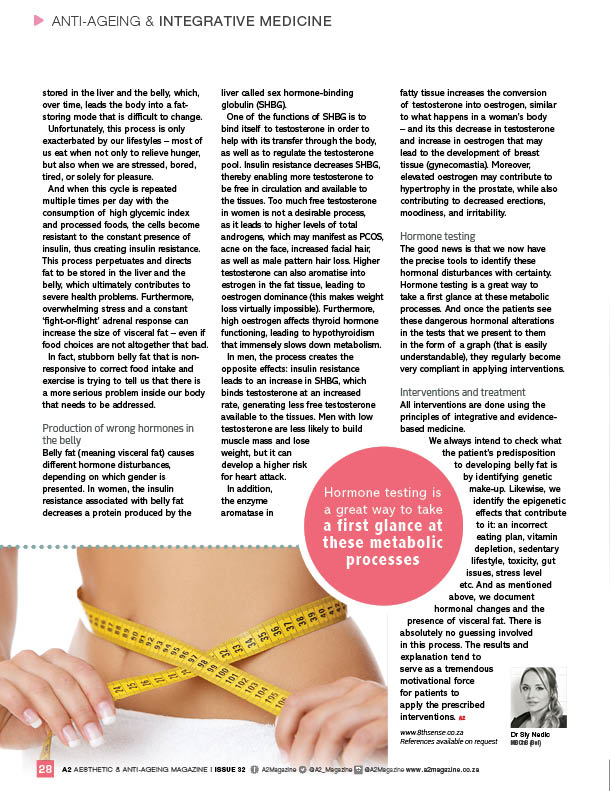
PRODUCTION OF WRONG HORMONES IN THE BELLY
Belly fat, meaning visceral fat, causes different hormones disturbances depending on which gender is presented. In women, the insulin resistance associated with belly fat decreases a protein produced by the liver called sex hormone-binding globulin (SHBG).
One of the functions of SHBG is to bind to testosterone to help with its transfer through the body and to regulate the testosterone pool. Insulin resistance decreases SHBG, enabling more testosterone to be free in circulation and available to the tissues. For women, too much free testosterone is not a desirable process as it leads to higher levels of total androgens, which may manifest as PCOS, acne on the face, increased facial hair, as well as male pattern hair loss. Higher testosterone also can aromatize into estrogen in the fat tissue, leading to estrogen dominance, and making a loss of weight virtually impossible. Furthermore, high estrogen affects thyroid hormone function, leading to hypothyroidism that immensely slows down metabolism.
In men, the process creates the opposite effects: insulin resistance leads to an increase in SHBG, which binds testosterone at an increased rate, generating less free testosterone available to the tissues. Men with low testosterone are less likely to build muscle mass and lose weight, but they can develop a higher risk for heart attack.
Furthermore, enzyme aromatase in fatty tissue increases the conversion of testosterone into estrogen, similar to what happens in a woman’s body. This decrease in testosterone and an increase in estrogen associated with visceral fat may lead to the development of breast tissue (gynecomastia). Additionally, elevated estrogen may contribute to hypertrophy in the prostate and also contribute to decreased erections, moodiness, and irritability.
The good news is that nowadays, we have precise tools to identify these hormonal disturbances, with certainty. Hormone testing is a great way to take a first glance at these metabolic processes. Once the patients see these dangerous hormonal alterations in the tests that we present to them in the form of a graph (that is easily understandable), they regularly become very compliant in applying interventions.
All interventions are done using the principles of integrative and evidence-based medicine.
We always intend to check what is the patient’s predispositions to developing belly fat by identifying genetic makeup. Furthermore, we identify the epigenetic effects that contribute to it: wrong eating plan, vitamin depletion, sedentary lifestyle, toxicity, gut issues, stress level, etc. And as mentioned above, we document hormonal changes and the presence of visceral fat. There is absolutely no guessing involved in this process. Results and explanation will serve as a tremendous motivational force for patients to apply prescribed interventions.
References available on request.