

TL;DR: Patients who need an immediate aesthetic result (an upcoming event, not enough time for slower collagen-building treatments) are their own category, needing honest expectation-setting and a treatment plan that trades long-term options for fast, visible results. A case study shows how fillers and botulinum toxin delivered that for a patient before her daughter’s wedding.
Aesthetic medicine is based on personalizing the treatment to each individual after fully understanding patients’ concerns and in-depth assessment of actual facial features (wrinkles, laxity, skin photodamage, volume loss, changes in bone structure, etc.) Interpreting patient goals and underlying motives have been the most challenging for an aesthetic practitioner in creating a suitable treatment approach. Additionally, an aesthetic practitioner confronts many other aspects of a patient’s diversity: age, ethnicity, gender, and potential facial irregularities. Conveniently many studies have been conducted to help an aesthetic practitioner classify patients’ goals and make applying aesthetic skills much more effortless. One such example is the “Going Beyond Beauty” initiative that was conducted to evaluate the motives for seeking aesthetic treatments: “Data from over 54,000 participants in 17 different countries were clarified into four distinct patient types based on motivating factors, aesthetic goals, initial treatment requests, and treatment opportunities and challenges.” These types were named:
- Beautification (“I want to look more attractive”)
- Positive aging (“I want to look more rejuvenated for my age- the best version of myself”)
- Transformation (“I want to transform my face, lips, chin, cheeks”)
- Correction (“I need to correct my facial irregularity, asymmetry, scars, big nose, etc.”)
In reality, patients who need beautification might need positive aging and correction of some facial features, and aesthetic doctors need to explain all of these approaches to a patient. Luckily, after proper explanation, many patients understand these approaches and are willing to undergo prescribed aesthetic procedures to fulfill their goals. Usually, this will lead to a trustworthy long-term doctor-patient relationship. And that relationship is a clear sign that doctors understood patients’ primary motivation for an aesthetic procedure and managed to satisfy patients’ expectations. But the extra challenge might arise when one patient’s primary goal is an immediate improvement.
Patients seeking an immediate aesthetic improvement
One particular group of patients that cannot be classified in any of the above groups is patients who desperately need immediate improvement. They are usually in a hurry to achieve a desirable look because of the important upcoming event. They were not necessarily interested in the aesthetic procedure before the event. They are eager to do whatever it takes to accomplish the wanted look, sometimes rushed and impulsive in their decisions. Here, often unrealistic expectations need to be absolutely matched by the aesthetic practitioner, requiring in-depth consultation. Besides, many aesthetic procedures can deliver that desirable look but it could take time.
The Case study of a patient who wanted an immediate improvement
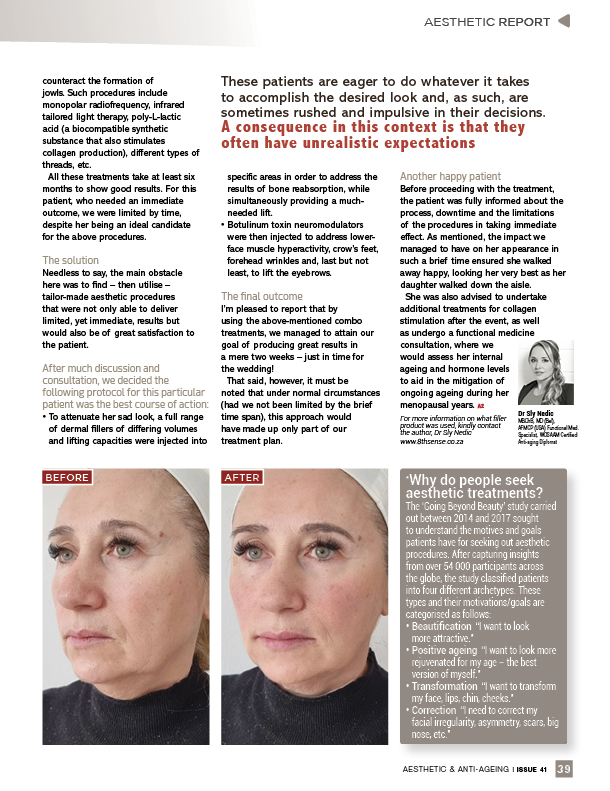
This 53-year-old lady (on the photos) wanted a non-surgical procedure that could improve her sad-looking appearance and jowls before her daughter’s wedding. Her case would be the usual one that aesthetic doctors often see, if it was not accompanied by a request for immediate results (the wedding was scheduled in three weeks). In creating the most suitable aesthetic approach, we needed to assure that both patient and the aesthetic doctor agreed on which method would be applied and which results would be achieved.
In this process, the following was done:
- We took a history related to the patient’s concerns, motivation, goals, previous aesthetic procedures, underlying medical conditions, lifestyle influence, etc. It is essential to mention that this patient has been in menopause for the past four years, and that would grossly affect the patient’s collagen content and (in)ability to fight free radicals. In other words, the aging process in an estrogen deficient woman is more rapid compared to one in perimenopausal period or younger. The study has shown that Collagen type I and II decrease by 30% in the first five years from the menopausal beginning. This patient clearly demonstrates this collagen loss, with visible jowls and sagging eyelids representing increased skin laxity. One must always consider that any procedure done on menopausal skin is facing limited repair.
- We examined all signs of aging in all structures, from bones to skin. We concluded that her primary concerns – a sad look & jowls are indeed a result of combination aging. These are bone reabsorption, soft tissue descending, increased skin laxity, loosening of the surrounding ligaments, loss of muscle tone in one group of muscles (the effect of growth hormone insufficiency), and hyperactivity in another group of muscles, etc.
- In a rapidly aging patient, such as our patient, who loses substantial amount of collagen (which contributes to jowls formation), we suggest a procedure that can stimulate collagen production. Such procedures are Thermage- a monopolar radiofrequency, Titan – infrared tailored light, poly-L-lactic acid (PLLA) – a biocompatible synthetic substance that also stimulates collagen production, different types of threads, etc. All these procedures take at least six months to show good results. For this patient, who needed immediate results, we were limited by time, despite her being an ideal candidate for it.
- We were therefore forced to use the aesthetic procedure that delivered limited but immediate results for the patient’s exceptional satisfaction. We managed to attenuate the patient’s sad look. We used the full range of dermal fillers with a different volume and lifting capacity to substitute bone reabsorption and simulate a lift. Under normal circumstances, if we were not limited with time, this approach would be only a part of our treatment plan. We used a botulinum toxin for the lower face muscle hyperactivity, crow’s feet wrinkles, and forehead wrinkles expecting the results only in two weeks, just in time for the wedding!
- Patient was fully informed about the process, downtime, and the limitations of the procedures for immediate effect. She was also advised to do additional techniques for collagen stimulation after the event. Furthermore, we recommended the Functional Medicine consultation, where we would assess her internal aging and hormones for substantial attenuation of ongoing aging in menopause.
Resources: 8thsense.co.za