

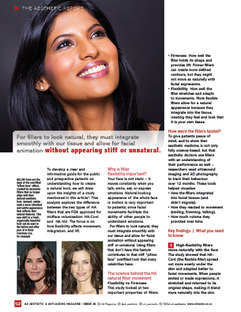
Many celebrities are choosing to dissolve their fillers in pursuit of a more natural look. Over time, some have realized that the overfilled “pillow face” effect created by excessive fillers no longer aligns with their desired appearance. Instead, they seek a more refreshed and subtle look that reflects their natural features. For some, this decision comes after experiencing what’s often called “filler fatigue.” After repeated treatments in search of that perfect look, they start to look unrecognizable or face lumps, asymmetry, or an overall unnatural result, leading to dissatisfaction with their appearance. Some celebrities’ unnatural look is most noticeable during facial animation and smiling, making it especially apparent in acting.
Beyond personal concerns, changing beauty standards have also played a role. There has been a noticeable shift away from the heavily filtered “social media face” appearance, with more people embracing natural beauty. As celebrities open up about their experiences with filler removal, their influence encourages others to do the same—often without even understanding the true reason behind it. This has created the misconception that all fillers give an unnatural look and should be avoided or dissolved, which is far from the truth. Additionally, the fear of “filler migration” has become a growing concern, unnecessarily discouraging many potential patients who could significantly benefit from filler treatments.
Aging naturally affects the face by causing volume loss, sagging, and wrinkles. Many people seek hyaluronic acid (HA) fillers to restore volume, smooth out fine lines, and create a youthful look. However, not all fillers are the same—some are firm and structured, while others are soft and flexible. And although the word “acid” might sound harsh, HA fillers are truly gentle products that give us instantaneous results which, in the right physician’s hands, create the most natural look.
To present to the public and potential patients a comprehensive guide to HA fillers and to understanding how to create a natural look we will use a study bellow. This study explores the difference between two types of HA fillers FDA-approved for midface volumization: HA-Cont and HA-Vol to help both patients and practitioners understand how these products behave in the face. The focus is on how flexibility affects movement, integration, and lift.
Why Is Filler Flexibility Important?
Your face is not static—it moves constantly when you talk, smile, eat, or express emotions. Natural-looking appearance of the whole face in motion is very important to patients, since facial movements facilitate the ability of other people to understand emotions. For fillers to look natural, they must integrate smoothly with our tissue and allow for facial animation without appearing stiff or unnatural. Using fillers that don’t have this feature contributes to that stiff “pillow face” overfilled look that many celebrities have.
This study looked at two important properties of fillers:
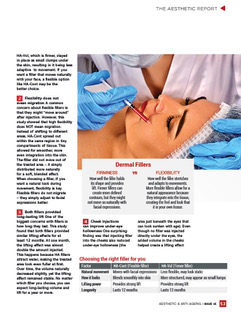
- Firmness – How well the filler holds its shape and provides lift. Firmer fillers can create more defined contours, but they might not move as naturally with facial expressions.
- Flexibility – How well the filler stretches and adapts to movements. More flexible fillers allow for a natural appearance because they integrate into the tissue, creating the feel and look that it is your own tissue.
How Were the Fillers Tested?
To give patients peace of mind and show that aesthetic medicine is fully science-based—and that aesthetic doctors use fillers with an understanding of their performance—researchers used ultrasound imaging and 3D photography to track their behaviour over 12 months. These tools helped visualize:
- How the fillers integrated into facial tissues (and didn’t migrate!)
- How they reacted to movement (smiling, frowning, talking)
- How much volume they provided over time
Key Findings: What You Need to Know
- High-Flexibility Fillers Move Naturally with the Face
The study showed that HA-Cont (the flexible filler) spread out more evenly under the skin and adapted better to facial movements. When people smiled or made expressions, it stretched and returned to its original shape, making it blend more naturally into the skin. HA-Vol, which is firmer, stayed in place as small clumps under the skin, making it less adaptive to movement. If you want a filler that moves naturally with your face, a flexible option like HA-Cont may be the better choice.
- Flexibility Does Not Mean Migration
A common concern about flexible fillers is that they might “move around” after injection. However, this study showed that high flexibility does NOT mean migration. Instead of shifting to different areas, HA- Cont spread out within the same region in tiny compartments of tissue. This allowed for smoother, more even integration into the skin. The filler did not move out of the treated area—it simply distributed more naturally for a soft, blended effect. When choosing a filler, if you want a natural look during movement, flexibility is key. Flexible fillers do not migrate—they simply adjust to facial expressions better.
- Both Fillers Provided Long-Lasting Lift
One of the biggest concerns with fillers is how long they last. This study found that both fillers provided similar lifting effects for at least 12 months. At one month, the lifting effect was almost double the amount injected. This happens because HA fillers attract water, making the treated area look even fuller at first. Over time, the volume naturally decreased slightly, but the lifting effect remained stable. No matter which filler you choose, you can expect long-lasting volume and lift for a year or more.
- Cheek Injections Can Improve Under-Eye Hollowness
One surprising finding was that injecting filler into the cheeks also reduced under-eye hollowness (the area just beneath the eyes that can look sunken with age). Even though no filler was injected directly under the eyes, the added volume in the cheeks helped create a lifting effect in that area. This means that treating the cheeks alone may be enough to improve a tired or hollow appearance under the eyes. Obviously, if the cheek area is overfilled or the wrong filler is used, it will have a counter-effect and draw more attention to that unnaturally looking area.
Choosing the Right Filler for You
| Factor
|
HA-Cont (Flexible Filler)
|
HA-Vol (Firmer Filler)
|
| Natural movement
|
✅ Moves with facial expressions
|
❌ Less flexible, may look static
|
| How it looks
|
✅ Blends smoothly into skin
|
❌ More structured, may appear as small lumps
|
| Lifting power
|
✅ Provides strong lift
|
✅ Provides strong lift
|
| Longevity
|
✅ Lasts 12 months
|
✅ Lasts 12 months
|
What This Means for You
If you’re considering fillers, working with a skilled injector is essential. A professional who understands these differences, applies research, and continues education in this field will assess your face, discuss your goals, and help you choose the best product for your unique features. A skilled injector will go through your most important questions:
- Do you want a natural look?
- Are you concerned about migration?
- How long do fillers last?
- How safe is that particular filler?
And don’t forget—the best filler is the one that matches your goals after you have an informed consultation with your injector, not the one chosen based on social media endorsements or celebrity trends.
Resources www.8thsense.co.za written by Dr Sly Nedic
Reference: Split-Face Comparison of Two Hyaluronic Acid Fillers: Intersection of Rheology and Tissue Behavior in Midface Rejuvenation
Steven F Weiner, MD, Jessica A Hicks, PhD, Thu Nguyen, PhD, Matthew Meckfessel, PhD Aesthetic Surgery Journal Open Forum, Volume 7, 2025, ojaf006, https://doi.org/10.1093/asjof/ojaf006