
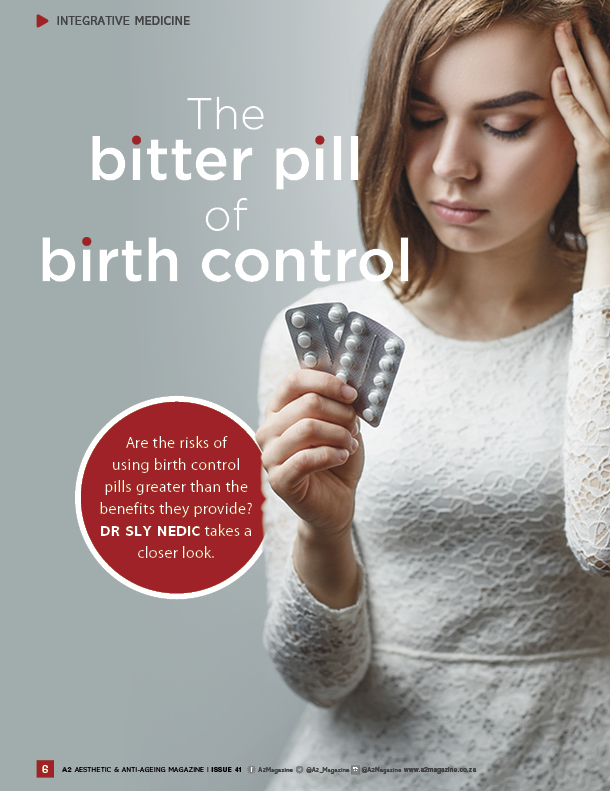

Are the risks of using a Birth Control Pill greater than the benefits it provides?
Since its first introduction in the sixties, hundreds of millions of women have taken the Birth Control Pill (Oral Contraceptives). There are more than 100 million women in the world currently using it. In South Africa, it is a preferred way of contraception. It is routinely prescribed for contraception and menstrual cramps, irregular menstrual cycle, PCOS, endometriosis, acne, heavy flow, etc. Hence, something intended to be used as birth control becomes the most (ab)used medication for any hormonal problem. From the functional medicine perspective, Oral Contraception(OC) to mask the actual hormonal problem will never remove that hormonal problem. It is logical even to a non-medical person. The moment the Birth Control Pill is stopped, all initial hormonal issues will reoccur.
Studies in Canada, the USA, and Europe showed that more than half the women aged 16-24 have started on the contraception pill for menstrual cycle problems, often in as young as fourteen. This approach is problematic because it takes 12 years for ovulation and the menstrual cycle to be properly established. Are these young girls and parents not adequately educated about the healthy menstrual cycle? The consequences of such an early start of Birth Control Pill can be detrimental, and ongoing research keeps proving its dangerous effects.
Doctors prescribing a pill usually refer to it as “safe” as it is nowadays used in a smaller dose. Also, they apparently cause fewer side effects than one used 15- 20 years ago. However, doses of 15-30 micrograms of Ethinyl estradiol are still four times more than normal, and in many contraceptive formulations, they are combined with progestin. Progestin is a well-known carcinogen. Both of these hormones can have long-term consequences.
Some immediate side effects of the Birth Control Pill:
- Migraines and headaches
- Nausea
- Breast tenderness
- Weight gain
- Mood swings
- Spotting and irregular bleeding
- Yeast overgrowth
Many young girls don’t experience any of these symptoms and thus continue consumption without knowing the possible long-term dangerous effects. Alarmingly, the majority have never been informed about them before taking the pill.
What your doctor probably did not tell you:
- The Belgium researchers found that long-term use of contraception pills may increase clogging in your blood vessels, which may raise your risk of heart attack and stroke. (It was as much as 30 % increased prevalence of arteriosclerosis for every ten years of oral contraceptive use.)
- Females who take Oral Contraceptives have a higher predisposition for breast cancer.One recent study concluded that” both current uses of contemporary OC preparations for five years or longer and a lifetime of OC duration of use of 15 years or longer confer an increased breast cancer risk among women ages 20-44 years.”
- Birth Control Pills decrease bone density, and women taking them increase their risk for osteoporosis at a younger age.
- Studies also showed that women taking birth control had a 40 % increased risk of developing depression in the following six months compared to women who did not. This was predominantly in adolescents.
- Birth control pills increase the risk of blood clots (thromboembolism), and stroke, and this is the case even with new formulations.
- Body perceives the artificial estrogen in the Birth Control Pill to be a dangerous substance. It increases the concentration of a protein ( SHBG) that carries estrogen and testosterone and appears to be protective of dangerous estrogens. As more dangerous estrogen is carried away, less protein is available for testosterone, significantly decreasing women’s libido.Studies suggested that even after stopping Birth Control Pill, that protein remains high, contributing to long-term reduced libido.
- One terrifying recent study showed that women who used oral contraceptives for more than 3 years had a doubled risk of developing glaucoma, an important cause of vision loss and blindness.
- Methylation (a detoxification part) is important for our neurotransmitters’ metabolism, energy production, gene silencing, sleeping cycle, heavy metal detoxification etc. However, the artificial estrogen found in the Birth Control Pill works as a “thief” by stealing one of the significant components in this methylation process. As a result, almost every organ and system in our bodies are negatively affected.
- During the Restorative Medicine Congress (USA) held recently, it was mentioned that the alarming decrease in fertility could be due to the use of the pill in the teenage population before their ovulation has been established firmly. There are also some preliminary studies about it. Are we creating a new generation of infertile women by introducing the birth control pill to teenage girls too early for the treatment of acne, heavy flow, irregular cycles, and cramps? One study confirmed that taking the Birth Control Pill can decrease the risk of ovarian cancer, but is this even comparable to all the other dangerous effects?
What Functional Medicine Suggests:
- All hormonal-related issues PCOS, endometriosis, fibroids, heavy menstrual flow, painful periods, etc., need to be treated using a functional medicine approach. Finding the root cause is essential for reversing the hormonal issue. Many of these diseases are estrogen dominance-related. PCOS is an insulin resistance-driven process. It makes so much more sense to treat these underlying conditions than to mask them with Birth Control Pill.
- For young girls struggling with cramps and irregular periods, it should be again applied a functional medicine approach respecting the time necessary to establish regular ovulation and cycle that might take years.
- For contraception: non-hormonal IUD, diaphragms, condoms, Symptom-thermal method, natural family planning method, spermicides etc.
- Acne should be treated with a functional medicine approach, understanding the root causes ( hormonal, stress, gut issues, detoxification problems). This internal treatment should be combined with topical and aesthetic treatments such as LED therapy, lasers, chemical peels etc.
The risks of using a Birth Control Pill are clearly greater than the benefits it provides.
Indeed, taking a pill should be done after detailed information about benefits versus danger has been pointed out to young girls, their parents, or women considering taking it. Every woman should be well informed and given the choice of less dangerous substitutes for contraception and additional pathologies.
Resources: www.8thsense.co.za